At the beginning of a school year (as a veteran educator) there is so much that I own as the adult leader in a classroom environment
I own my responsibility to provide quality information to the people in the room
I own the mistakes in my own analysis
I own the outcomes of failed experiments (knowing that there is as much to be learned in things that don’t work as there is in things that do…perhaps even more)!
These are OPPORTUNITIES to release perfection and lean on the moment. The safety of getting things “right” the first time is often a trap of false security that creates toxic culture and thinking.
This time of year is also the beginning of the end of outdoor sports. I love to watch tennis and CG is emerging as one of the greatest in the game right now. She understands that “losses make wins more special”! Applying sage notions about life to her tennis game–her job and daily flow. This interview and its key messages about coaching are not obvious by this headline and thumbnail.
As educators, we perhaps have bought into the idea that we can “fix” what is broken:
In schools
In students
In communities
We can’t.
The Truth About Reading and The Right to Read loom large in my thinking about what is happening right now. Who am I? What am I supposed to be doing when so many people are struggling?
Everything that CG said in that interview is making me think about what we must do as teachers–be coaches that remind students that they did not come to us empty or with-out.
“We can guide them, challenge them, hold up mirrors to help them see what they cannot see by themselves…”
We betray the community when we stop believing they can (and we can) be solutions to problems.
We have an important relationship with our work and the people in our workspaces. We can’t fix them (nor should we try). We have to trust that approaching the work with honesty and integrity will be sufficient.
Life is full of lyrics that tell us how to live and to love.
When Seasons Changelearning to celebrate fallen leaves is about appreciating that they are making room for new ones.
Growth is the expectation.
Understanding that Breaking Up Is Hard To Do helps you to know that every generation has its chance to see young love, old love, immature crushes or mature risk-taking relationships all have their sacrifices. You can go into it eyes slivered in admiration and aspiration or wide open with promise and potential, there is always the chance that the players have not been totally honest with your heart or your hopes…it is ok. Keep do, do, wahhing…
I think about how quickly break ups can devolve into unhealthy obsessions, inescapable from misery and darkness–preoccupation with something that doesn’t want you, can’t see you, and definitely does not know you–whether you or it–it warns you that “Every Breath You Take” it is watching. The part it doesn’t say is that it admires you, it misses you, it needs you but pride gets in the way. You (and it) made mistakes. You (and it) missed cues. If you ignore them any more, it will haunt you and maybe harm you deeply…right now, the wounds are superficial.
Fatally toxic is not like the temporary Poison that comes with the lure of a beautiful moment. Remember what sparkles on the outside may be concealing something dangerous. Protect yourself…flow like water…it will flush away some of the mess.
From chocolate to cherries, your life will be sweeter, healthier, fuller when you let it go…if it was for you, it will come back BUT what lies ahead is an opportunity to take what you have learned and be even better than before.
Get on that plane and shine with a clear head my son…I am doing the same. Pack light. Carry-ons are always better than checked bags. Take that freedom and Keep On Walkin.
Almost 250 years after the Declaration of Independence in the United States and almost 70 years after it was first written, I am picking up Here I Stand, a collection of essays written by Paul Robeson. There is no doubt that with these essays, collated in 1958, he was making a definitive statement about the racial segregation and animus toward Black folks but there is something in them that belongs to all of us and speaks to the potential we have as American citizens to both stand and say something about this moment.
He wrote:
There is a rapidly growing awareness that despite all of our differences it is necessary that we become unified, and I think that the force of that idea will overcome all barriers. Coordinated action will not, of course, come all at once: it will develop in the grass-roots and spread from community to community. And the building of that unity is a task which each of us can undertake wherever we are (p. 98).
Here I Stand, 1958/1971/1988
Then my mind acquiesces, inspired but not racing, to the lyrics of Ballad for Americans. A cantata—a patriotic song—recorded in 1940! Imagining how (and perhaps why) a Black man would lend his voice to such a song in 1940. Then it hit me, he was a well-traveled American who believed in the potential of his young nation. With its promises of liberty for all, he gave voice to the aspirations of the generations of people who expected freedom as a standard of living. He sang for the “nobodies” who were everybody who believed it! Written by Latouche and Robinson and recorded with the American People’s Chorus…
He sang: (Chorus responses are right justified)
Part 1
In seventy-six the sky was red
Thunder rumbling overhead
Bad King George couldn’t sleep in his bed
And on that stormy morn, Ol’ Uncle Sam was born.
Some birthday!
Ol’ Sam put on a three cornered hat
And in a Richmond church he sat
And Patrick Henry told him that while America drew breath
It was “Liberty or death.”
What kind of hat is a three-cornered hat?
Did they all believe in liberty in those days?
Nobody who was anybody believed it.
Ev’rybody who was anybody they doubted it.
Nobody had faith.
Nobody but Washington, Tom Paine, Benjamin Franklin,
Betsy Ross organized a sewing circle. Paul Revere had a horse race.
And a little ragged group believed it.
And some gentlemen and ladies believed it.
And some wise men and some fools, and I believed it too…
Imagine that! A choir of Americans, singing, together!
My next thoughts on the eve of the semiquintentennial are taking me to all the traditions of family and belonging we have in the United States around holidays. How at every cookout, you are likely to hear the same stories embellished a little differently as time passes. Filtered through aging memories of the family griots or molded more concretely in the minds of the listeners as they grow older and wiser to nuance…either way, the lyrics change…and it is ok.
So I end my tribute to Robeson thinking about how over time he used his voice to craft important messages to us about revolution as evolution required…
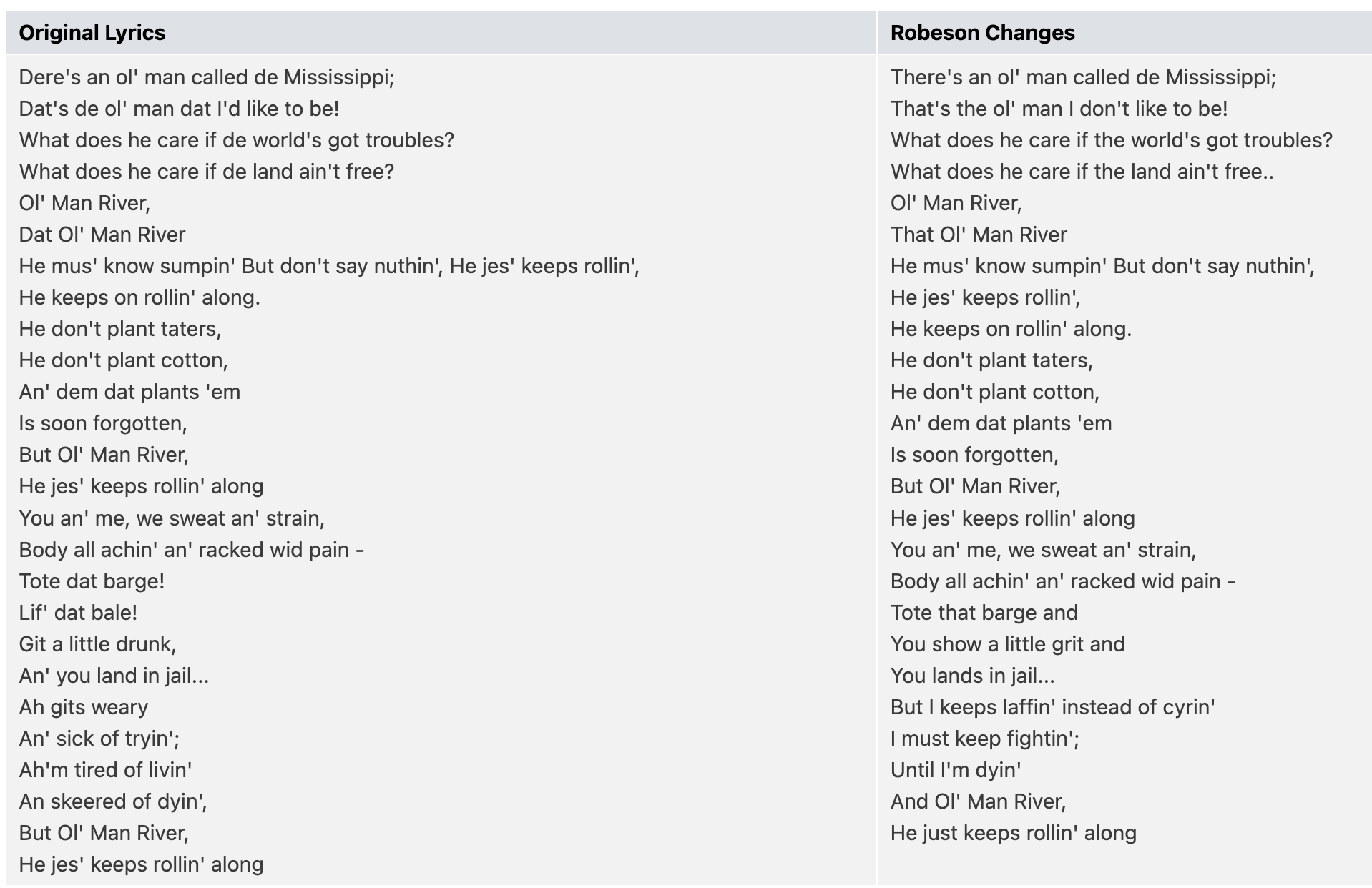
One of his most famous performances, him singing Ole Man River whether in a concert hall or as it was first performed on screen changed all of us even as he—the artist—changed it (Robeson, 1960). This is the American way! Changing lyrics is not the same as revising history. Changing lyrics is a way to give voice to protest and correct stereotypes, poor executions, or inadequate accounts.
As we celebrate the birth of this nation—one established by protest and grappling with its identity among its superpower siblings who are much older than we are—I honor Paul Robeson as an American hero. His voice still rings in my mind as Princeton’s Native Son. Here we stand.
References
Robeson, P., Stuckey, S. (., & Brown, L. L. (. (1988). Here I Stand. Beacon Press.
Kwanzaa Day 2: Kujichagalia means self-determination
Using white text is catching on! I have been using it for years…I always suspected machines were reading what the naked eye could not see. Now I know it is. As I reflect on the principles of Kwanzaa this year, I can’t help but think about artificial intelligence (AI).
The first time I created a resume using “white ink”, I saw it as adding a personal touch that I knew was there even if its human reader could not see it. I couldn’t afford the fancy linen paper that was often circulated in the 90s on those early career interviews–when T2 was still one of the hottest science fiction movies of the day! Were the questions given to destroy or protect the young woman I was learning to become? Unsure, perhaps even afraid to show who I really was, I would turn the background of every resume gray for myself and print my professional life story out for myself in white text while handing my evaluator the white copy…staying somewhere between black and white, unsure about just what to say…my youth seen as arrogance, my being seen as less; I didn’t know who would show up to tell me what they thought I was…it is strange to hear myself say that I used whiteness to assure myself of truths my reviewer could never see. Wearing a digital mask made of text on a page…
Now, it seems hidden text is everywhere.
Fast forward twenty years, AI tools are reading and writing whole life stories for people–machines are defining us and some of us are co-signing on all of it. Contributing data by the second as we scroll endlessly all day, invoke Siri and Alexa to answer what we refuse to look up and expecting our life to be maintained by the apps at our fingertips.
The tools some imagine to help us get ahead are doing so much more to keep us behind. Like a trap set for vulnerable prey, college professors and other power players are changing expectations even as the technologies evolve (and as they use them to do their own work). They are defining students by the tools they use–classical canons and scholarly traditions, modern discussions with other humans, or the technological strategies and AIs they engage. This new school classification is complicated. Some smart, most dumb, few genius and all cheating. Is anything ever that black and white?
I want to stay somewhere in the gray space. We need to know AI’s promise and its problems. We need to always define ourselves based on our own reflection (in mirrors and in minds), our own cultures (of community, language, art and family) and our own voice. We are carrying the spirit of our ancestors when we do this. We must remember this gift…always.