Tag: history

Robeson: Voice of an American on 3 July 2026

Almost 250 years after the Declaration of Independence in the United States and almost 70 years after it was first written, I am picking up Here I Stand, a collection of essays written by Paul Robeson. There is no doubt that with these essays, collated in 1958, he was making a definitive statement about the racial segregation and animus toward Black folks but there is something in them that belongs to all of us and speaks to the potential we have as American citizens to both stand and say something about this moment.

He wrote:

There is a rapidly growing awareness that despite all of our differences it is necessary that we become unified, and I think that the force of that idea will overcome all barriers. Coordinated action will not, of course, come all at once: it will develop in the grass-roots and spread from community to community. And the building of that unity is a task which each of us can undertake wherever we are (p. 98).

Here I Stand, 1958/1971/1988

Then my mind acquiesces, inspired but not racing, to the lyrics of Ballad for Americans. A cantata—a patriotic song—recorded in 1940! Imagining how (and perhaps why) a Black man would lend his voice to such a song in 1940. Then it hit me, he was a well-traveled American who believed in the potential of his young nation. With its promises of liberty for all, he gave voice to the aspirations of the generations of people who expected freedom as a standard of living. He sang for the “nobodies” who were everybody who believed it! Written by Latouche and Robinson and recorded with the American People’s Chorus…

He sang: (Chorus responses are right justified)

Part 1

In seventy-six the sky was red

Thunder rumbling overhead

Bad King George couldn’t sleep in his bed

And on that stormy morn, Ol’ Uncle Sam was born.

Some birthday!

Ol’ Sam put on a three cornered hat

And in a Richmond church he sat

And Patrick Henry told him that while America drew breath

It was “Liberty or death.”

What kind of hat is a three-cornered hat?

Did they all believe in liberty in those days?

Nobody who was anybody believed it.

Ev’rybody who was anybody they doubted it.

Nobody had faith.

Nobody but Washington, Tom Paine, Benjamin Franklin,

Chaim Solomon, Crispus Attucks, Lafayette. Nobodies.

The nobodies ran a tea party at Boston.

Betsy Ross organized a sewing circle. Paul Revere had a horse race.

And a little ragged group believed it.

And some gentlemen and ladies believed it.

And some wise men and some fools, and I believed it too…

Imagine that! A choir of Americans, singing, together! 

My next thoughts on the eve of the semiquintentennial are taking me to all the traditions of family and belonging we have in the United States around holidays. How at every cookout, you are likely to hear the same stories embellished a little differently as time passes. Filtered through aging memories of the family griots or molded more concretely in the minds of the listeners as they grow older and wiser to nuance…either way, the lyrics change…and it is ok.

So I end my tribute to Robeson thinking about how over time he used his voice to craft important messages to us about revolution as evolution required…

One of his most famous performances, him singing Ole Man River whether in a concert hall or as it was first performed on screen changed all of us even as he—the artist—changed it (Robeson, 1960). This is the American way! Changing lyrics is not the same as revising history. Changing lyrics is a way to give voice to protest and correct stereotypes, poor executions, or inadequate accounts.
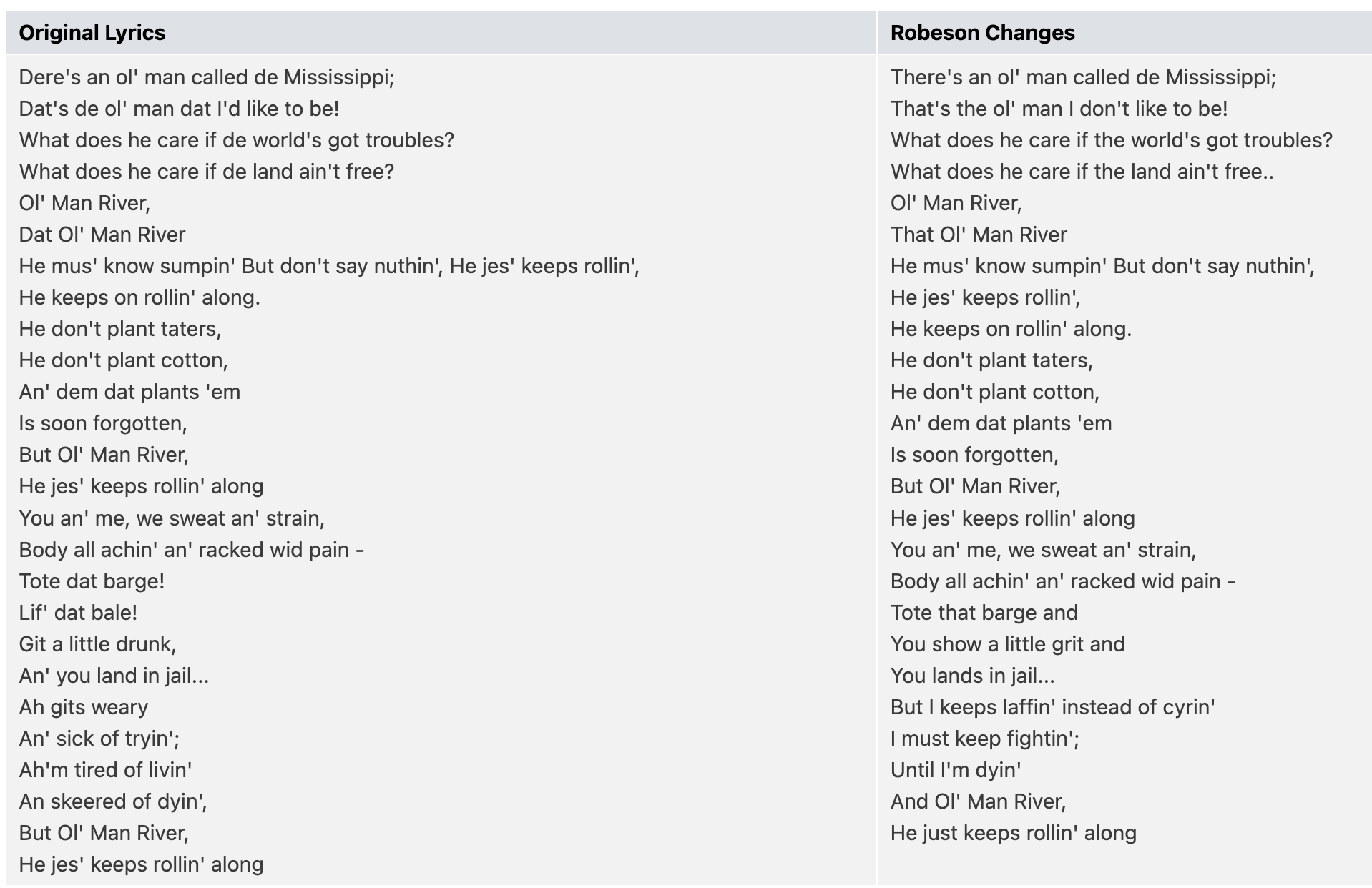
As we celebrate the birth of this nation—one established by protest and grappling with its identity among its superpower siblings who are much older than we are—I honor Paul Robeson as an American hero. His voice still rings in my mind as Princeton’s Native Son. Here we stand.

References

Robeson, P., Stuckey, S. (., & Brown, L. L. (. (1988). Here I Stand. Beacon Press.

Robeson, P. L. (1960). Ole Man River (Sample) [Audio]. Alexander Street. https://video.alexanderstreet.com/watch/paul-robeson-performs-ole-man-river-for-construction-workers-at-sydney-opera-house

Rutgers University Libraries. (n.d.). Lyric Changes. New Jersey Digital Highway. Retrieved July 3, 2026, from https://njdigitalhighway.org/lesson/paul_robeson/lyric_changes

Re-Membering US

I asked a group of children, Bb children, why Black History Month is celebrated during the month of February. None of them knew…then I realized, many do not know why. Our history and culture has been caricatured so much that the memes and messages about our heroes and contributions to societal strength are unknown.

I draw from a well that runs deep

Deep like the rivers

Of Mississippi, Hudson, Passaic, Raritan and Delaware

Emptied from the Senegal, the Congo or maybe the Nile

Whose soils and softened shores I have never known...

Uncertain and yet I care

To know and wonder.

I wrote an essay on February 2nd 2020 called Why We Need BHM in Times of BLM, unsuspectingly, days before the world shut down. I wrote it as a model for students to demonstrate how to tie “old texts” into new contexts and document important perspectives. Reflecting on it now, I still love it but I realize it is not enough. 

This entry is a love letter to them…a reminder to the children of BB, Bb, and bb genotypic character who find themselves in an America that would be oddly familiar to our ancestors that we have a history and a heritage of excellence in the United States. To the Black and Brown children, adult and young, we have heroes, super and elegantly normal, who deserve to be celebrated and re-membered in our times and forever.

Look at what AI will do with a style guide and prompt…do you see us? In this moment, is this us?

Here are some of our heroes…now ancestors whose love for us shines brightly…

Frederick Douglass

Sojourner Truth

Ida B. Wells

Anna Julia Cooper

Charles Henry Turner

Percy Julian

George Washington Carver

James Weldon Johnson

Booker T. Washington

Madam C.J. Walker

W.E.B. DuBois

Pauli Murray

Thurghood Marshall

Walter White

Katherine Dunham

Josephine Baker

Barbara Jordan

Gwendolyn Brooks

Toni Morrison

Ralph Bunche

Bayard Rustin

Mary McLeod Bethune

Henrietta Lacks

John H. Johnson

Robert S. Abbott

Nikki Giovanni

Ella Baker

Septima Clark

Fannie Lou Hamer

Carter G. Woodson

This is who we are…in every shade of brown, our Black is beautiful. In every body, male, female and non-gendered, we are human and dignified. We are re-membered like pieces of a puzzle being put together…what you see is only part of the full tale.

These are just a few of my heroes, restoring their legacies in my memory and right-now consciousness. There are many people who have made US better; lifting every voice in this moment, I hear and see our past and celebrate how it made US, how it made me. Their stories help guide US in this moment because we have been here before. Their DNA is ours. Their stories are our own. We are not our ancestors, we are surely not better than them…we are them.

Gemstones of Multicultural Education: Celebrating Milestones in Education Theory

Like this AI-generated geode, the layers of necessary discussion that we need to have in 2024 are both tragic and brilliant. Tragic because our abuse of the natural world is so profound that gems like this are rarely discovered anymore. Brilliant because at some point in human history, we have imagined this beauty…in all of its glory and intention…we can see it. The slow process that creates magnificently large crystals and the fast-pace of change that reveals the stones after a storm.

Image available online at https://www.freepik.com/premium-ai-image/closeup-shot-blue-gold-crystal-sapphire-geode-gemstone-with-selective-focus-depth-field_334373811.htm

This piece is a celebration of multicultural education’s past, present and future in the discourse about reform. In 1974, James A. Banks published an editorial in the ASCD journal that admonished educators to uphold a type of cultural pluralism that celebrates diversity as a strength and ideal product of democracy. Fifty years later and only days after a national election that has many people wondering ‘what’s next?’ our commitment as citizens must be to education…learning that empowers us to be better humans. In his editorial, he wrote:

…the school has a responsibility to teach a commitment to and respect for the core values such as justice, equality and human dignity expressed in [American] historical documents…

Written 50 years ago, these words have reached GOLDEN ANNIVERSARY status. In search of definitions and goals for multicultural education, James Banks’ works have formed an important foundation for generations of educators since.

Written 30 years ago, as a foreword to a brilliantly written book, Scholar John Henrik Clarke, gave us pearl statements about solidarity when he wrote:

What is the relationship between the dominant modes of European thought and the dominant modes of their behavior towards others? If the people in Africa and Asia and the former European colonies are to emerge into full independence, statehood and world responsibility, they will have to answer the above question creatively and in their favor. Then, in a collective sense, they will have to participate with others in a world that can be free, that can recognize European influence without accepting European dominance (p. xvii)

Thirty years is the PEARL ANNIVERSARY. We are Black pearls, unique and special, fabricated and precious.

Written 25 years ago, Geneva Gay first published her treatise on culturally responsive teaching. A guide for the field on theory, research and practice, the seminal work has served as a guide for so many…like flecks of silver embedded in native rock, the material left untouched is taken for granted. Chipping away at the outside though, you can see its simple brilliance, especially if you listen as it is excavated from the noise of rigid structure that only yields in disaster.

Twenty-five years is the SILVER ANNIVERSARY; a hard-fought victory of longevity for those who can achieve it.

How do we, in education, celebrate small milestones: one year or five? Education Week knows how…the PAPER ANNIVERSARY and the SAPPHIRE ANNIVERSARY are great opportunities to be reflective on where we have been and what we have done as teachers. Cultivating Genius (2020) and Unearthing Joy (2023) are right there! Gholdy Muhammad’s works are joining this beautiful mine of gems about multicultural education. Providing frameworks for equity, she challenges us to form cultivating genius and joy collectives…we can do it.

Happy Anniversary.