Life is full of lyrics that tell us how to live and to love.
When Seasons Changelearning to celebrate fallen leaves is about appreciating that they are making room for new ones.
Growth is the expectation.
Understanding that Breaking Up Is Hard To Do helps you to know that every generation has its chance to see young love, old love, immature crushes or mature risk-taking relationships all have their sacrifices. You can go into it eyes slivered in admiration and aspiration or wide open with promise and potential, there is always the chance that the players have not been totally honest with your heart or your hopes…it is ok. Keep do, do, wahhing…
I think about how quickly break ups can devolve into unhealthy obsessions, inescapable from misery and darkness–preoccupation with something that doesn’t want you, can’t see you, and definitely does not know you–whether you or it–it warns you that “Every Breath You Take” it is watching. The part it doesn’t say is that it admires you, it misses you, it needs you but pride gets in the way. You (and it) made mistakes. You (and it) missed cues. If you ignore them any more, it will haunt you and maybe harm you deeply…right now, the wounds are superficial.
Fatally toxic is not like the temporary Poison that comes with the lure of a beautiful moment. Remember what sparkles on the outside may be concealing something dangerous. Protect yourself…flow like water…it will flush away some of the mess.
From chocolate to cherries, your life will be sweeter, healthier, fuller when you let it go…if it was for you, it will come back BUT what lies ahead is an opportunity to take what you have learned and be even better than before.
Get on that plane and shine with a clear head my son…I am doing the same. Pack light. Carry-ons are always better than checked bags. Take that freedom and Keep On Walkin.
Almost 250 years after the Declaration of Independence in the United States and almost 70 years after it was first written, I am picking up Here I Stand, a collection of essays written by Paul Robeson. There is no doubt that with these essays, collated in 1958, he was making a definitive statement about the racial segregation and animus toward Black folks but there is something in them that belongs to all of us and speaks to the potential we have as American citizens to both stand and say something about this moment.
He wrote:
There is a rapidly growing awareness that despite all of our differences it is necessary that we become unified, and I think that the force of that idea will overcome all barriers. Coordinated action will not, of course, come all at once: it will develop in the grass-roots and spread from community to community. And the building of that unity is a task which each of us can undertake wherever we are (p. 98).
Here I Stand, 1958/1971/1988
Then my mind acquiesces, inspired but not racing, to the lyrics of Ballad for Americans. A cantata—a patriotic song—recorded in 1940! Imagining how (and perhaps why) a Black man would lend his voice to such a song in 1940. Then it hit me, he was a well-traveled American who believed in the potential of his young nation. With its promises of liberty for all, he gave voice to the aspirations of the generations of people who expected freedom as a standard of living. He sang for the “nobodies” who were everybody who believed it! Written by Latouche and Robinson and recorded with the American People’s Chorus…
He sang: (Chorus responses are right justified)
Part 1
In seventy-six the sky was red
Thunder rumbling overhead
Bad King George couldn’t sleep in his bed
And on that stormy morn, Ol’ Uncle Sam was born.
Some birthday!
Ol’ Sam put on a three cornered hat
And in a Richmond church he sat
And Patrick Henry told him that while America drew breath
It was “Liberty or death.”
What kind of hat is a three-cornered hat?
Did they all believe in liberty in those days?
Nobody who was anybody believed it.
Ev’rybody who was anybody they doubted it.
Nobody had faith.
Nobody but Washington, Tom Paine, Benjamin Franklin,
Betsy Ross organized a sewing circle. Paul Revere had a horse race.
And a little ragged group believed it.
And some gentlemen and ladies believed it.
And some wise men and some fools, and I believed it too…
Imagine that! A choir of Americans, singing, together!
My next thoughts on the eve of the semiquintentennial are taking me to all the traditions of family and belonging we have in the United States around holidays. How at every cookout, you are likely to hear the same stories embellished a little differently as time passes. Filtered through aging memories of the family griots or molded more concretely in the minds of the listeners as they grow older and wiser to nuance…either way, the lyrics change…and it is ok.
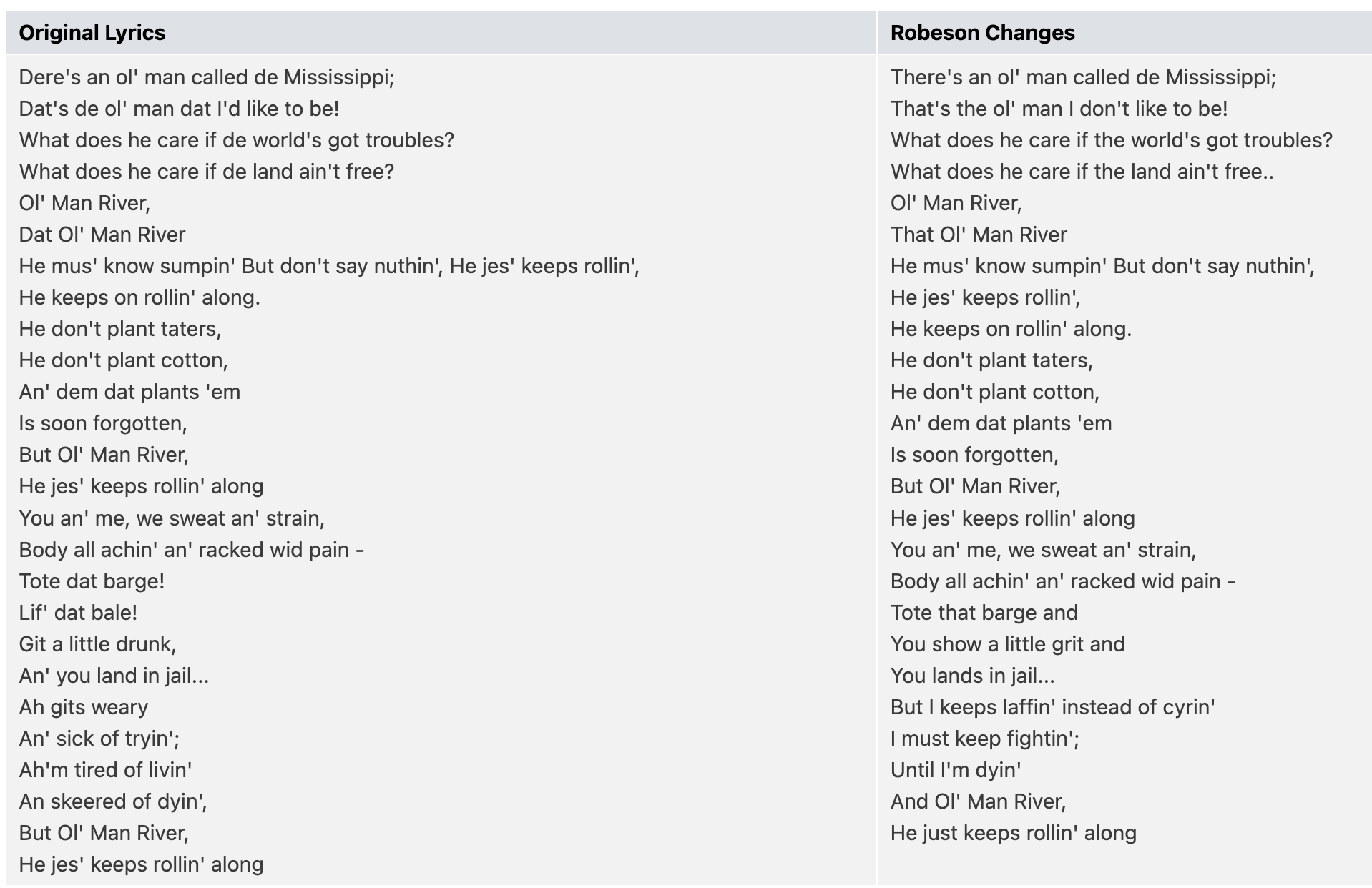
So I end my tribute to Robeson thinking about how over time he used his voice to craft important messages to us about revolution as evolution required…
One of his most famous performances, him singing Ole Man River whether in a concert hall or as it was first performed on screen changed all of us even as he—the artist—changed it (Robeson, 1960). This is the American way! Changing lyrics is not the same as revising history. Changing lyrics is a way to give voice to protest and correct stereotypes, poor executions, or inadequate accounts.
As we celebrate the birth of this nation—one established by protest and grappling with its identity among its superpower siblings who are much older than we are—I honor Paul Robeson as an American hero. His voice still rings in my mind as Princeton’s Native Son. Here we stand.
References
Robeson, P., Stuckey, S. (., & Brown, L. L. (. (1988). Here I Stand. Beacon Press.