“…it dawned upon me with a certain suddenness that I was different from the others; or like, mayhap, in heart and life and longing, but shut out from their world by a vast veil. I had thereafter no desire to tear down that veil, to creep through; I held all beyond it in common contempt, and lived above it in a region of blue sky and great wandering shadows. That sky was bluest when I could beat my mates at examination-time…” (DuBois, 1897)
“…confusion and doubt in the soul of the black artist; for the beauty revealed to him was the soul-beauty of a race which his larger audience despised, and he could not articulate the message of another people.” (DuBois, 1897)
50 years ago The American dream to own a home got the politicians to broker with the banks. They developed policy to make home ownership affordable for nearly anyone. Special incentives were invented to encourage even folks who had no money for a down payment to seek homes through assistance programs—because “home ownership provides an opportunity to build equity and wealth.” No one questioned how these programs would build exponential wealth for the bankers and the politicians.
30 years later
The plot thickens. At just about the time the first generation home owners payed nearly three times their original loan amount (in interest) to finally earn the deed to their homes, a new idea was launched. Offer home equity loans at a low rate. Encourage home owners to buy big ticket items with their loans—things they always wanted but were unable to buy without saving. And to further discourage the…
It is time for 2020 Vision…that which sees forward by looking at events past. It is our Sankofa moment. Our kujichagalia time…
Black History Month is as relevant today as it was 100 years ago. When Dr. Carter G. Woodson wrote “not to know what one’s race has done in former times is to continue always as a child” (April, 1926), he was imagining the value of education to broaden and deepen the self concept of the progeny of the African in America, a country whose constraining institutions rendered this progeny nearly helpless in their ignorance of self. Their goals for the week–he did not work in isolation–read a lot like our demands in the movement to honor Black Lives at School (BLM@School). On the eve of the week, I share thoughts from the pages of the Journal of Negro History, a legacy publication established in the sociological imagination of Dr. Woodson and his contemporaries.
With prophetic accuracy, Dr. Woodson describes the broken promises of participation of this progeny in politics, work, education, housing. He outlines power struggles that are born out of a lack of space–physical or abstract–for brown bodies (black bodies) in a land valued for white bodies.
By 1927, the second annual celebration of the week, he clearly articulates the goal:”to save and popularize the records of the race that it may not become a negligible factor in the thought of the world” (p. 104), By 1927, Woodson encouraged educators to expand education to include ancient triumphs and continental Africa’s intellectual treasure, its capital, as a social, cultural, geological and political force of power and authority. At the same time, he acquiesced (perhaps) to brand Negro History Week, History Week as he nods on the page to the contributions of the dominant groups from Europe and the United States.
He summarized the goals and accomplishments of this movement in education:
To create a demand for Negro pictures and literatures
To disabuse the Negro mind of the idea of inferiority
To increase understanding in a key principle about racial bias: it undermines ALL truth
To establish a global research agenda in the study of Negroes
Mandate Black history and ethnic studies in K-12 schools
Hire more Black teachers
Fund counselors not cops
Whether you embrace the 13 principles by hanging posters or leading lessons, make Black Lives visible, listen for their voices, celebrate their stories, expect them to be great but support them as they grow. Resist the temptation to accept false narratives and stereotypes, or gaze at their joys or pains…celebrate Black lives in the United States and across the globe as it is lived now and in historical context.
REFERENCES
Woodson, C. G. “The Celebration of Negro History Week, 1927.” The Journal of Negro History, vol. 12, no. 2, 1927, pp. 103–109. JSTOR, http://www.jstor.org/stable/2714049.
While racial differences in health care outcomes are due to differences in health behaviors, education and income, mistrust of the health care system by African Americans and other People of Color also plays a role. Austin Frakt describes racism in the health system and gives examples of communication barriers and racial stereotyping, such as the legacy of the Tuskegee Syphilis Study and the sterilization of nonwhite women without consent and at times coerced. To read the article, click here.
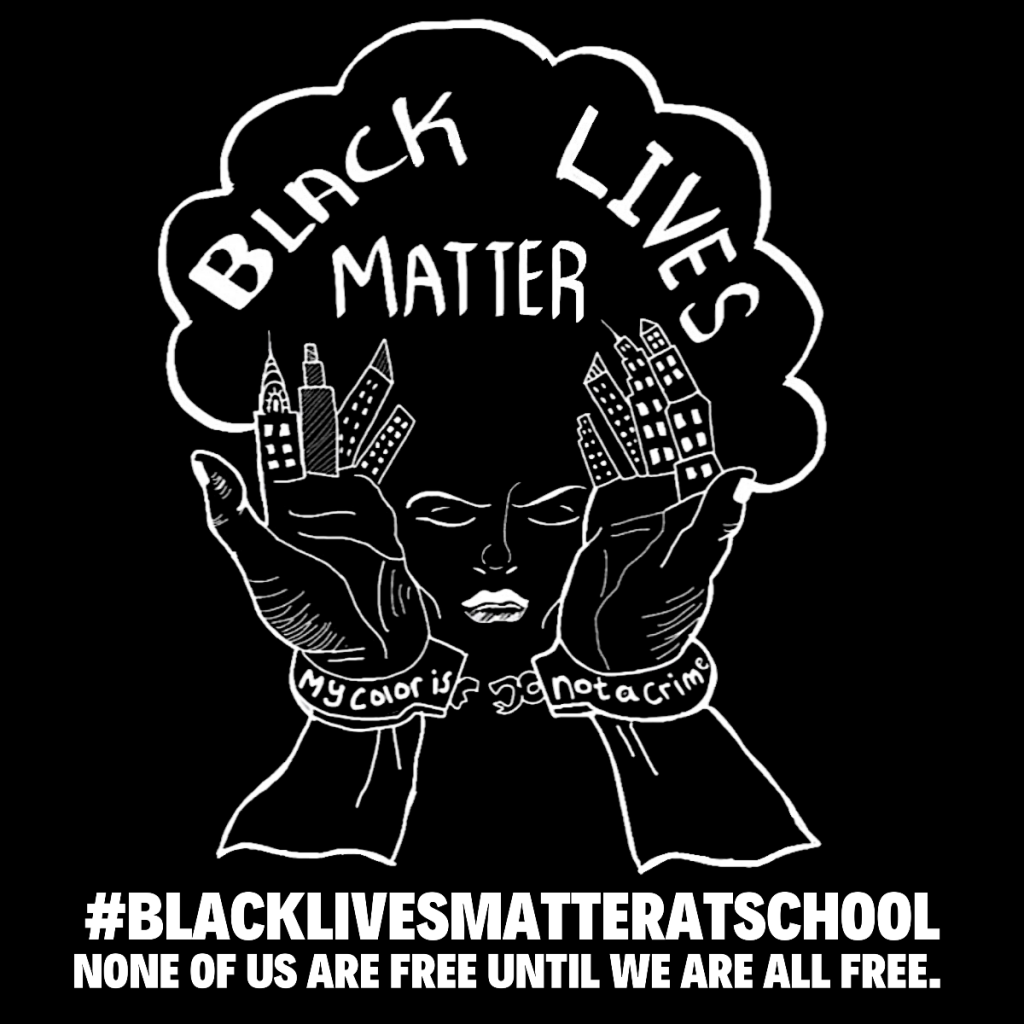
The student-designed logo contest winner was designed by Fabiha Ahmed, a high school student at Bard High School in Queens. She writes: “This attributes to my school Bard High School Early College Queens and Dr. Kadison and Ms. Mary Jo Lombardo for supporting me and encouraging me to compete in this contest. I would also like to attribute it to all of the students who have shown support for this movements and the art.”
We place these shirts on TeeSpring at the cheapest price that the site allows. We HIGHLY ENCOURAGE that if you are ordering more than 5-10 shirts, email us and get the direct logo from us. Take it to a locally-owned, preferably Black-led t-shirt print shop for a much better rate and much faster delivery! We place these here for convenience, not as an endorsement. Email us at blacklivesmatteratschool2 “at” gmail.com.
This week has been filled with so many gifts, daily benefits of
Courageous
Confrontational
Conversations
That were seeking not to save but to liberate…me…perhaps. When things hurt, and we are wounded, it is our questions (I think) that promote healing when answers we cannot find. Mind-freeing questions, the beginning of a conversation can be the source of liberation. I have always thought of questions (especially a barrage of them) as tools of manipulation, prying from me hidden secrets that I was not ready to release…today, I realize their power to help bridge gaps and promote healing. So I recount this past week’s treasures as I yield to their musing.
Sunday’s question with Rev. Sylvia: where does life begin my friend, girl, sister, daughter, woman?
Me: At breath queen mother, preacher, teacher, sister, daughter woman.
Monday’s question with Mommy: why would you say that joy?
Me: Because I see your fatigue queen mother, leader, teacher, sister, daughter woman.
Tuesday’s question with Rev. Jeri: how do you feel sissy?
Me: Tired but grateful queen like me, preacher, teacher, sister, daughter, woman.
Wednesday’s question from me to them–my students–on the first day of our year together: what matters most to you…in the context of us?
Them: Silence, curious silence of uncertainty awaiting.
Thursday’s question: can we play? Of course I say. With bubbles and flame, let’s ask more as we explore.
Friday’s questions: what is? why does? how can? The answers don’t matter, today, yet…until the second group of students, a medley of harmony-seeking freshman, gathered at a round table with us–the warriors leading demonstrations, protesting injustice. They asked “what is wrong in this town?” In this place, where the surface sparkles from light cast on glossy ivy among cathedra though cold, we all wondered. I inhaled their curiosities and exhaled a bit of myself, knowing there is no single answer that would satisfy or that could requite. Instead I hoped to inspire and invite them outside the gates of this sanctuary, this space…with me.
Saturday’s questions are many, too many, to ask or answer but one,
From a newly found stranger, who may become more
In a context of conquest and survival cultures
Where stories and lives and ways of being rise like love above the heads of the teachers
She asked: what if…
We convert old monuments (of the kind commissioned to honor un-civil war histories) into new things? I paused to reflect. I accepted the question like breath in dry bones or maybe like the breath in the lungs of a body formed from clay…
I thought about who erected those monuments in the first place…women. The daughters and sisters and wives and mothers of the wounded ones who lost… generations later,
still fueled by this rage
that justifies elections and
martyrs dying men.
Reminded of Inka Road where Indigenous monuments, ancient and sacred, had been set apart for worship gatherings yet ransacked and pilfered by White faces seeking self-interest…the more religious of the pirates knew that in re-appropriating broken stones and ground clay into foundations for their churches, the spirit of the earth would call her sons and daughters home…they knew…they knew.
Reminded as I read Kendi on the ride back, on the last day of this glorious week, that after failure, comes success, that teaches what we need to build the kind of hope that leads to survival in spite of cancer….aggressive, anticipated, metastatic or unexpected.
Kendi (2019) How To Be An Antiracist
Which brought me back to my Sunday, my family, my mother, her healing…on that first day of this week where wounds drain their toxins and the DNA of their former pain.
Our history and acceptance of our thoughts about our body, our space, our power…that have been the opposite of antiracist…
Final question as this week shows sign of the next: How do we survive the WOUNDS of our bodies’, spaces’ & powers’ failures to act? We choose to resist further sacrifice of our own flesh and spirit in order to be accepted. We choose to be who we are and are becoming as we celebrate the strength and beauty we behold in our mirrors. We choose to love. We choose to learn. We choose to lead.
Today is July 10, 2019. I’ve just returned from a national conference that empowered nearly 8000 very specific public service professionals to continue their diligence to take on the world.
I represented those who sent me there. I marched to a detention center that was illegally holding child immigrants. But none were freed.
I half-listened while 10 presidential candidates regurgitated what they were told was what the voters needed to hear to make them THE best choice. I came home exhausted and less reflective than I have in the past ten years.
We celebrated the millions of dollars that we raised to endorse an individual that will restore so many human rights that have been stomped-on, held hostage, and erased without the permission of the majority. We chanted, “this is what democracy looks like” as a tear ran down my cheek.
Is one that can only be born(e) by the one who carries
tears
Of joy
when others SEE you
In January…not yet, I guess winter is too long…
In February, being Black…American
In March, being woman…
In April, hearing, little or none, deaf…
In May, being Asian…Pacific Islander…American
In Summer from Memorial Day to Labor Day…American…just American of the U.S. variety…never mind that which is North or South or Central, beyond the 48 contiguous or territorized, colonized (or terrorized) in the oceans or the seas…
In September…in the middle…to the middle of October
then being Queer in October…in America
In November, being Indigenous in America…native
In December…back around to bear the weight of capital that comes in the form of indebtedness and frolicking that is heavy.
All year to be seen is important. To be represented on a calendar, in a school, in a bookstore or library display is to be celebrated from the inside out and outside in…is critical in the debate to be represented. WE ALL MATTER. WE KNOW THAT. For the marks made on a calendar, during the month that celebrates a heritage, perhaps others will see it too. New flavor of capital in each frame–social, cultural, powerful visions of who we have been before we carried who we are as Americans before we carry who we have been born to be…






 Joy Barnes-Johnson, Ph.D.